How the 100 envelope challenge works
Number 100 envelopes from 1 to 100. Each day, pick one you haven't filled yet and put that many dollars in it: envelope 12 gets $12, envelope 85 gets $85. When every envelope is full, you have $5,050.
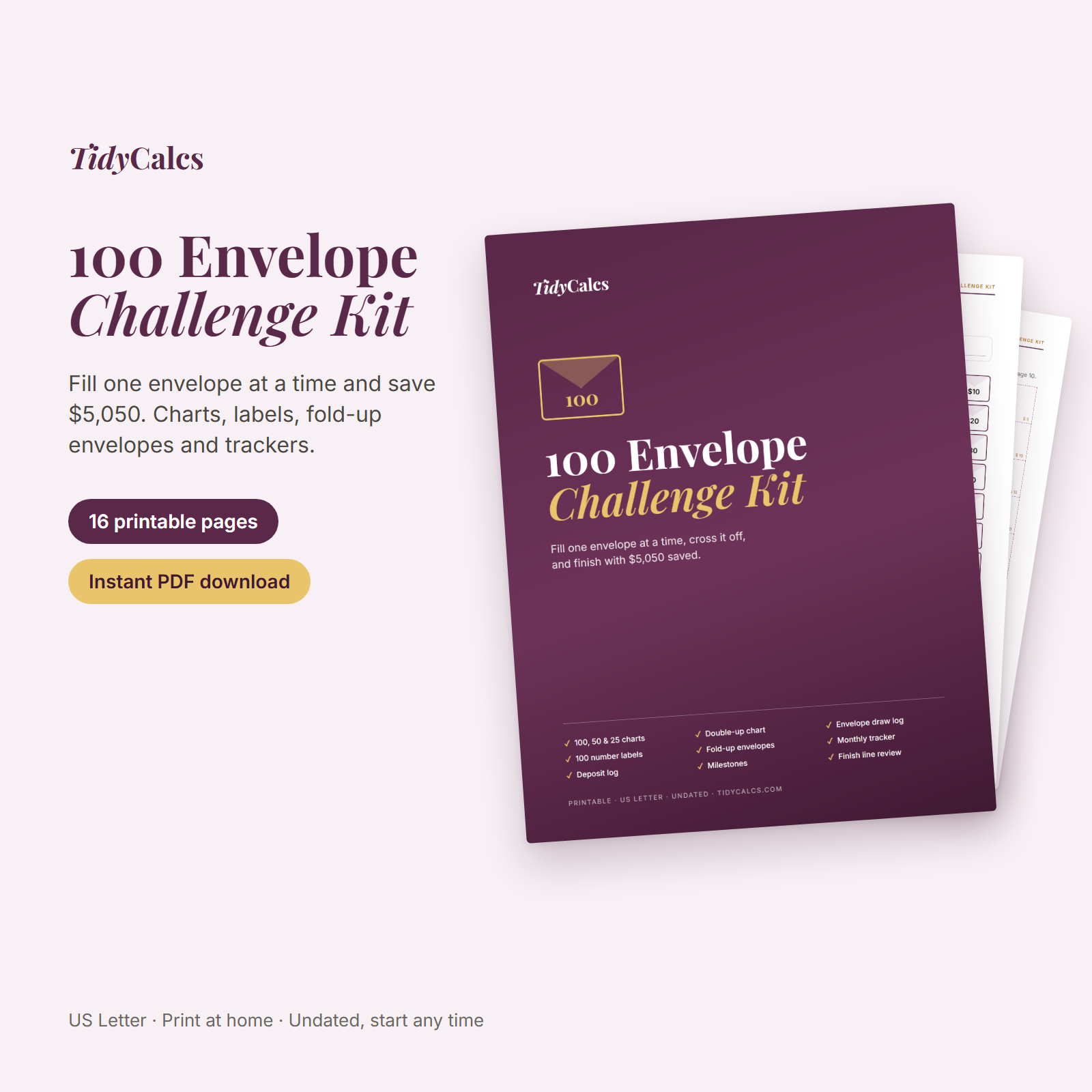
Because you choose the envelope, you can match it to the day. Tight week? Pull a small number. Just got paid? Take one of the big ones. The chart above does the same job without 100 paper envelopes: cross off a number each time you save that amount, and color in the progress bar as you go.
How much you will save, and how fast
The total depends on how many envelopes you use and how much each number is worth. The pace only changes how long it takes.
| Version | Total | One a day | Over 1 year |
|---|---|---|---|
| 100 envelopes, $1 each number | $5,050 | 100 days, ~$354/week | ~$97/week |
| 100 envelopes, $0.50 each | $2,525 | 100 days, ~$177/week | ~$49/week |
| 100 envelopes, $2 each | $10,100 | 100 days, ~$707/week | ~$194/week |
| 50 envelopes, $1 each | $1,275 | 50 days, ~$179/week | ~$25/week |
| 25 envelopes, $1 each | $325 | 25 days, ~$91/week | ~$6/week |
Be honest about the pace. One envelope a day for 100 days means finding about $1,500 a month, which is more than most budgets can spare. Stretching the same 100 envelopes over a year brings it down to about two envelopes a week. If you have a target amount and date in mind, the savings goal calculator shows what it takes per month.
Cash envelopes or a savings account?
Stuffing real cash into envelopes is satisfying, and seeing the stack grow is a big part of why the challenge took off. It has downsides, though. Cash earns no interest, it can be lost or stolen, and it is easy to borrow from "just this once."
- Hybrid: fill the envelope, then deposit the cash into a separate savings account once a week and cross the number off the chart.
- Cashless: skip the envelopes. Transfer the amount from checking to savings and cross it off. A high-yield savings account pays you a little extra for every envelope.
- All cash: keep the envelopes somewhere secure, like a locked box, and agree on a firm rule that the money stays put until the end.
Tips that make it stick
- Start with the 50 or 25 version if $5,050 feels like a stretch. Finishing a smaller challenge beats quitting a big one halfway.
- Use the random draw. The "Draw a random envelope" button above picks a number you can use for the day. Some people like the surprise; others prefer to choose.
- Save the big numbers for paydays. Envelopes 90 to 100 alone hold $1,045. Plan them for weeks with extra income, like a tax refund or bonus.
- Pin the chart where you see it. A page full of crossed-off envelopes is hard to walk away from.
Other savings challenges
If 100 envelopes feels like too much, the printable 52-week savings challenge spreads saving over a year in small weekly steps, starting at $1. Once you have a cushion, the printable emergency fund tracker keeps deposits and withdrawals in one place, and the printable monthly budget worksheet helps you find the money for each envelope in the first place.
For classes and workshops
Teachers, librarians and counselors are welcome to print and photocopy the chart. The blank version leaves the amounts empty, which makes a quick lesson in how 1 + 2 + 3 up to 100 adds up to 5,050.